Picture this: you’re anchored in a secluded cove, far from shore power, yet your refrigerator hums quietly, your navigation systems stay online, and your cabin lights work perfectly without the rumble of a diesel generator breaking the peace. This is the reality for yacht owners who’ve made the switch to solar power in 2026.
Solar panels have evolved from a nice-to-have accessory into essential equipment for serious cruisers. Modern marine solar technology delivers enough power to run critical systems indefinitely, eliminating range anxiety and reducing your carbon footprint with every nautical mile. The latest high-efficiency panels designed specifically for the marine environment can generate 400 watts or more from a single panel, meaning even a modest installation can produce 1,500 to 2,000 watts of clean energy daily.
The decision to install solar isn’t just about convenience or environmental responsibility, though both matter deeply. It’s about freedom. Freedom to extend your cruising season without worrying about battery depletion. Freedom to skip crowded marinas when you’d rather drop anchor somewhere pristine. Freedom from the noise, fumes, and maintenance headaches that come with running generators for hours every day.
But here’s what stops many yacht owners: confusion about which panels actually work in marine conditions, how many watts they truly need, and whether the investment pays off. Walk into any marine chandlery and you’ll face dozens of options with wildly different specifications, price points, and installation requirements.
The good news? Choosing the right solar setup for your yacht doesn’t require an engineering degree. You need practical guidance based on real-world cruising patterns, honest assessments of different panel technologies, and examples from sailors who’ve already made the transition successfully. That’s exactly what this guide delivers.
Why Yacht Owners Are Making the Solar Switch in 2026
The shift toward solar power on yachts isn’t just a trend, it’s a fundamental change in how serious cruisers approach energy independence. Walk any marina in 2026 and you’ll notice the difference: fewer generators rumbling at dawn, more pristine anchorages where yachts sit quietly for weeks without needing to run engines or head to dock.
The economics alone make a compelling case. Fuel costs have yacht owners rethinking their traditional power sources, especially those who cruise extensively or live aboard. Running a generator burns through diesel at 0.5 to 1 gallon per hour, and with fuel prices where they are, that expense adds up fast during extended passages or while anchored. Solar panels require zero fuel and negligible maintenance once installed, paying for themselves within a few seasons for most cruisers.
But it’s not just about saving money. The noise factor matters more than many people realize until they experience solar-powered quiet. Generators disrupt the peaceful anchorage experience both for you and your neighbors, making early mornings and late evenings less pleasant. Solar harvests energy silently while you sleep, swim, or simply enjoy being on the water.
Environmental responsibility drives many yacht owners to solar as well. The marine environment we all cherish deserves protection, and reducing your vessel’s carbon footprint while cruising aligns with that stewardship. Every hour you avoid running fossil-fuel-powered generators means less exhaust entering coastal waters and pristine anchorages.
The benefits extend beyond environmental and economic factors:
- Extended cruising range without seeking marinas or fuel docks
- Continuous battery charging during daylight hours, even while sailing
- Reliable power for navigation electronics, refrigeration, and essential systems
- Independence from shore power in remote anchorages
- Reduced engine hours, lowering maintenance requirements
Perhaps the most significant advantage is the freedom solar provides. You’re no longer tethered to marinas or fuel docks, and you can explore remote coastlines without worrying whether your batteries will support refrigeration and electronics overnight. That independence transforms how you use your yacht, opening possibilities that weren’t practical before solar technology matured to its current reliability.
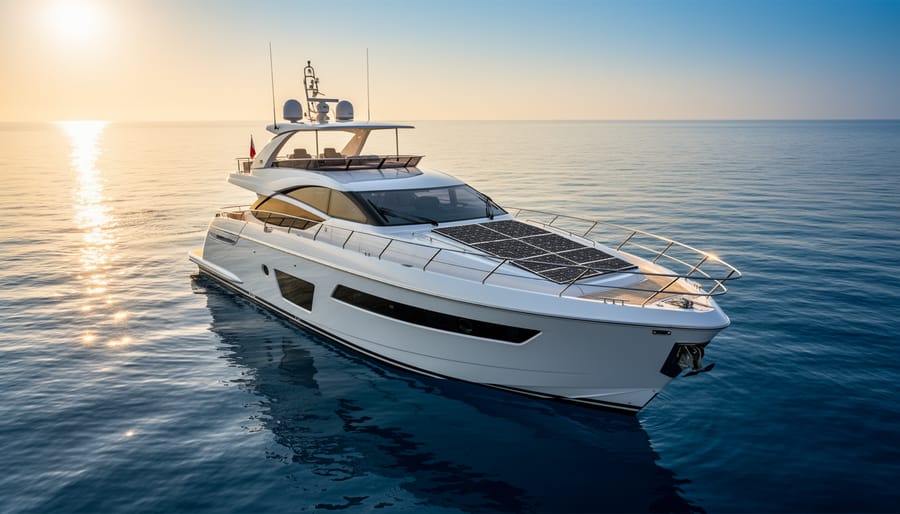
What Makes a Solar Panel Actually Work on a Yacht
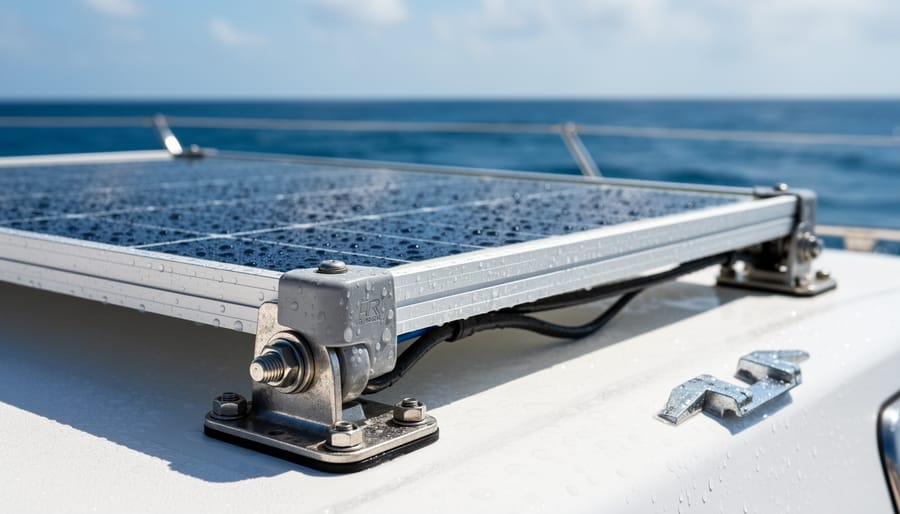
Understanding Efficiency Ratings for Marine Applications
Efficiency ratings tell you how much sunlight a panel converts into usable electricity. A 25% efficient panel turns one-quarter of the sun’s energy hitting its surface into power, while a 15% panel converts just 15%. That gap matters dramatically on a yacht where every square foot of mounting space counts.
Here’s the practical difference. A premium marine panel with Sunpower cells achieving 24.4-25.4%+ efficiency can produce roughly 50-60% more power from the same area as a standard 15-17% efficient panel. On a yacht’s hardtop or arch with limited mounting space, that translates to either getting the power you need or falling short. If you need 400 watts of generation and only have 20 square feet available, high-efficiency panels make it possible. Lower-efficiency options might require 30-35 square feet for the same output.
The efficiency advantage compounds when dealing with shading or less-than-ideal sun angles during morning and evening hours. Higher-efficiency cells extract more energy from marginal light conditions, which matters when you’re anchored in a cove with partial shade or cruising at dawn.
For cruisers with modest requirements, choosing panels in the 110-140 watt range with efficiency above 24% means fewer panels to mount, less weight aloft, cleaner aesthetics, and simpler wiring. You’re not sacrificing deck space or adding unnecessary complexity to achieve energy independence. When shopping, prioritize efficiency alongside durability. The difference between 24% and 17% isn’t just numbers on a spec sheet, it’s real power you can use.
Rigid vs. Flexible Panels: Which Belongs on Your Yacht
The choice between rigid and flexible panels shapes how solar integrates into your yacht’s design and performance for years to come.
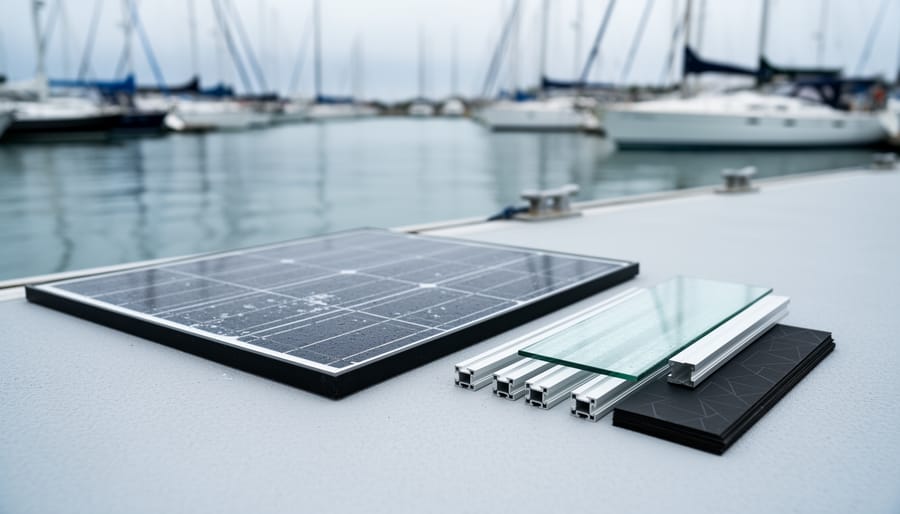
Rigid glass panels deliver superior durability and efficiency. These traditional panels feature tempered glass faces protecting high-performance cells, with marine-grade options using Sunpower cells achieving 24.4-25.4% efficiency. They withstand harsh saltwater environments better than flexible alternatives, and their aluminum frames provide robust mounting points for secure installation on hardtops, arches, or davits. The glass surface sheds salt spray and grime more easily, keeping panels producing at peak output with simple rinses. For yacht owners prioritizing maximum power output and longevity, rigid panels represent the proven standard.
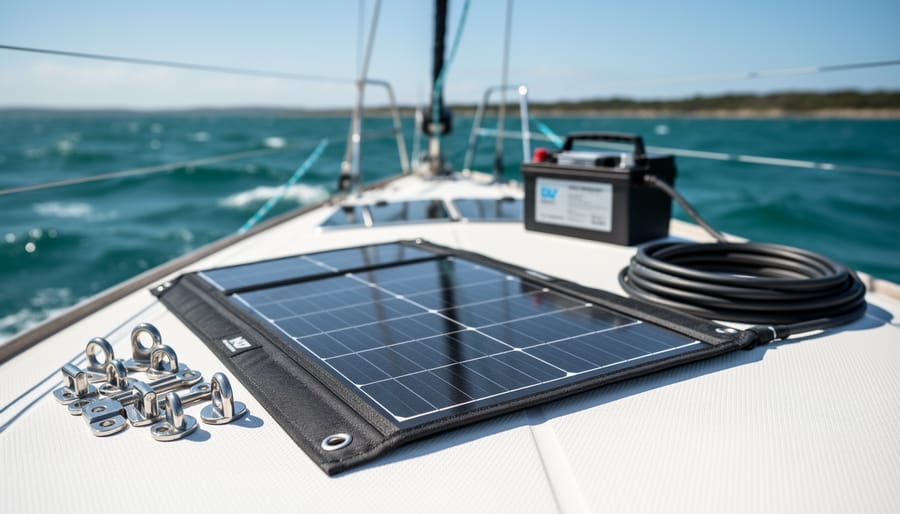
Flexible panels sacrifice some efficiency and lifespan for installation versatility. Built with thin-film technology laminated onto lightweight backing, they conform to curved surfaces like bimini tops or wrap slightly over cabin edges where rigid panels won’t fit. They weigh significantly less, sometimes half the weight of equivalent rigid panels, reducing stress on mounting structures and improving weight distribution. Installation becomes simpler with adhesive backing or sewn pockets, avoiding the need to drill through expensive yacht surfaces.
- Higher efficiency ratings (24-25%+) mean more power per square foot of limited deck space.
- Glass surface resists UV degradation and maintains performance 20+ years.
- Easier to clean and maintain in saltwater conditions.
- Stronger warranty coverage, typically 25 years for power output.
- Lower efficiency (typically 15-18%) requires more surface area for equivalent power.
- Shorter lifespan, often 5-10 years before noticeable degradation.
- Vulnerable to delamination and hotspots in marine humidity.
- Higher cost per watt of actual long-term energy production.
The right choice depends on your specific installation constraints. If you have solid mounting surfaces and prioritize maximum output, rigid panels deliver better value over their lifetime. Reserve flexible options for situations where their unique installation advantages genuinely solve a problem that rigid panels can’t address.
Sizing Your Solar System: How Much Power Does Your Yacht Really Need
Start with what you actually use, not theoretical capacity. Most yacht owners overestimate their solar needs and end up with unnecessary panels cluttering valuable deck space. The key is matching your real consumption to the right amount of generation.
Begin by tracking your daily power draw. Walk through your yacht and list every device that pulls from your battery bank: chartplotter, VHF radio, depth sounder, autopilot, cabin lights, refrigerator, water pump, fans, and any entertainment systems. Don’t forget small draws like USB chargers and phone docks that stay plugged in. Your chartplotter might pull 2-3 amps continuously while underway, the fridge cycles for maybe 50 amp-hours daily, and LED cabin lights add up surprisingly fast during evenings at anchor.
Add everything together for a 24-hour period at anchor, which represents your baseline solar requirement. If you’re running your fridge, navigation electronics on standby, and using lights in the evening, you might land around 80-100 amp-hours per day. A cruising yacht with modest requirements typically falls in this range. Those running air conditioning, electric winches, or extensive entertainment systems will see higher numbers.
Now translate that consumption into solar capacity. A 110-140 watt panel produces roughly 30-40 amp-hours per day in decent sun conditions, assuming a few hours of optimal angle. If your daily draw is 100 amp-hours, you’d need three 140-watt panels to break even on a sunny day, with some margin for cloudy weather or suboptimal positioning.
Here’s where reality intrudes: panels rarely operate at peak efficiency all day. Morning and evening sun hits at low angles, clouds pass through, and spray or salt haze blocks light. Build in a 20-30% buffer above your calculated need. If the math says 300 watts, install 400 watts. You’ll thank yourself during a string of overcast days.
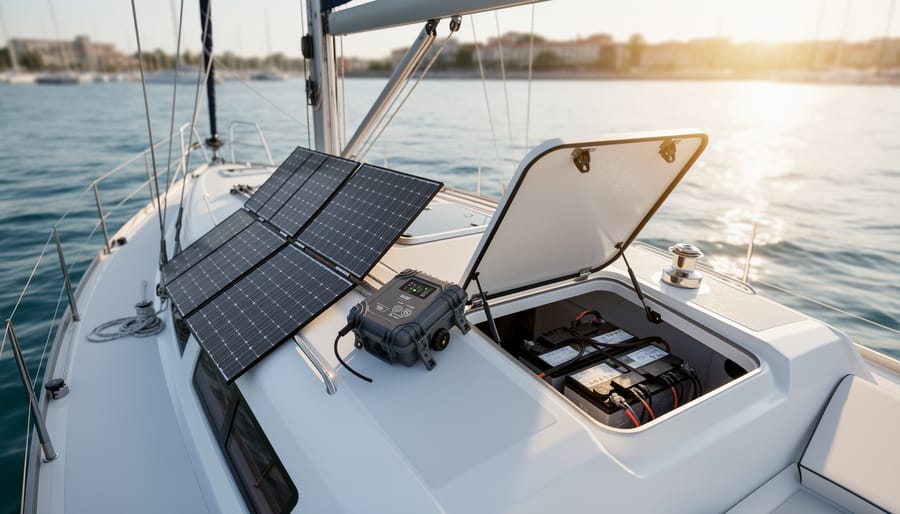
Consider your battery capacity too. Solar only helps if you have somewhere to store the power. A 400 amp-hour battery bank gives you roughly two days of autonomy with 100 amp-hours daily consumption, assuming you don’t drain below 50%. Match your panel array to refill what you use each day, not to charge the entire bank from empty.
For weekend cruisers who plug into shore power regularly, a single 110-140 watt panel often covers essentials and maintains batteries between trips. Liveaboards or extended cruisers need more substantial arrays. Your usage pattern matters as much as the numbers.
Top Solar Panel Options for Yachts in 2026
High-Efficiency Rigid Panels for Maximum Output
Rigid glass panels deliver the highest energy output in the smallest footprint, making them the go-to choice for yacht hardtops, arches, and biminis where mounting space is secure and protected. These panels typically use premium monocrystalline cells, top marine models feature Sunpower cells achieving 24.4-25.4% efficiency or higher, which means you’ll generate more power per square foot than any flexible alternative.
The real advantage shows up when you’re running multiple onboard systems simultaneously. A typical cruising yacht with modest power needs does well with 110-140 watt panels, but you’ll often see owners installing 200-300 watt rigid units to handle refrigeration, navigation equipment, and entertainment systems without generator assistance.
Construction quality separates marine-grade rigid panels from rooftop versions. Look for tempered glass that can handle the shock of waves and docking, marine-grade aluminum frames that resist saltwater corrosion, and sealed junction boxes that keep moisture out of electrical connections. The extra weight, usually 15-25 pounds per panel, isn’t a concern when you’re mounting to a solid hardtop or arch structure.
These panels sit flat or angled on fixed mounts, capturing consistent energy throughout the day. You’ll sacrifice some installation flexibility compared to flexible panels, but you gain durability that lasts 20-25 years in harsh marine conditions.
Walkable Panels for Deck Integration
Walkable solar panels solve one of yachting’s biggest compromises: you don’t have to choose between deck space and power generation. These specialized panels feature reinforced tempered glass and robust frames designed to handle crew weight, deck chairs, and the daily activities that happen on a working deck surface.
The key advantage is flush installation. Rather than mounting panels on arches or rails where they’re protected but take up valuable real estate, walkable panels integrate directly into deck areas you’re already using. This works particularly well on larger yachts where foredeck or cockpit surfaces can pull double duty without sacrificing aesthetics or functionality.
Durability is where walkable panels earn their keep. They’re engineered to withstand not just occasional foot traffic but repeated impact, flexing, and the constant stress of marine movement. The trade-off is typically a slight efficiency reduction compared to their non-walkable rigid counterparts, but the ability to maximize your installation area often compensates.
Most walkable options range from 100 to 200 watts per panel and maintain efficiency ratings around 20-22%, which remains respectable for practical yacht applications. Installation requires proper backing support and deck penetration sealing, so budget for professional mounting if you’re not experienced with marine deck work.
Bifacial Technology: Getting Power from Both Sides
Bifacial solar panels represent an underutilized opportunity for yacht owners, capturing sunlight from both the top and bottom surfaces to boost overall energy production. Unlike conventional panels that only absorb direct sunlight, bifacial models harvest reflected light bouncing off your yacht’s deck, an especially valuable feature given the high reflectivity of white gel coat and polished surfaces common on vessels.
The Lumera 100W Bifacial panel offers a practical entry point into this technology at $119.99 USD. This rigid, Canadian-made option positions cells to catch direct sun exposure while simultaneously converting the light reflected upward from deck surfaces below. In marine environments where sunlight reflects off water and light-colored decking, you gain 10-20% additional power compared to standard single-sided panels in the same footprint.
This matters on yachts because deck space commands a premium. Instead of adding more panels to meet your power needs, bifacial technology squeezes extra watts from the square footage you already have. The effect intensifies during midday when the sun’s high angle creates maximum deck reflection, precisely when cooling and refrigeration loads peak aboard.
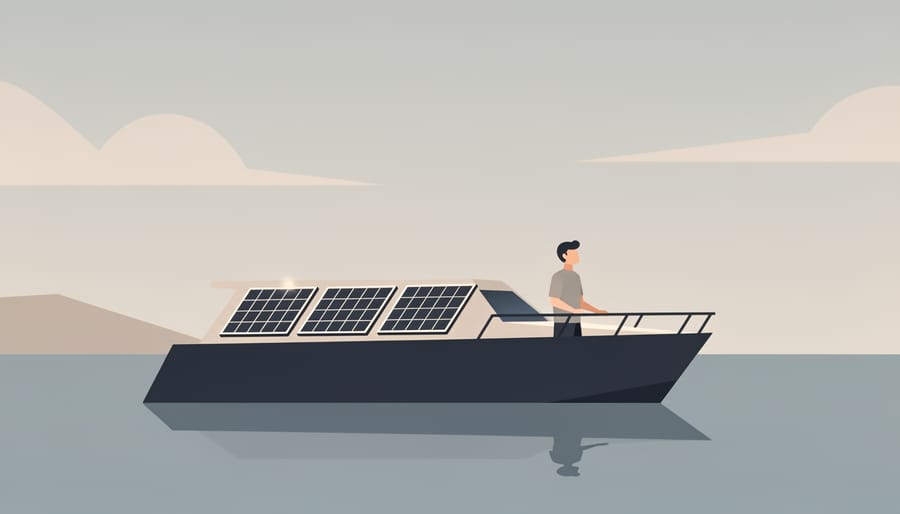
Installation Considerations That Make or Break Your System
The best solar panels in the world won’t deliver if they’re poorly installed. Marine environments demand precision, saltwater spray, constant motion, and extreme weather will expose every shortcut.
Panel positioning determines how much energy you actually capture. Your yacht’s latitude and typical cruising grounds matter here. In the Caribbean, mounting panels flat on a hardtop works fine because the sun sits nearly overhead. Higher latitudes benefit from tilting panels 15-20 degrees toward the equator. Watch for shade patterns throughout the day. That radar arch casting shadows at 3 PM cuts your afternoon production significantly.
Mounting hardware must handle the marine environment’s abuse. Stainless steel (316 grade minimum) resists corrosion far better than cheaper alternatives that pit within months. Adhesive-only mounting seems appealing for flexible panels, but mechanical fasteners provide critical backup when adhesive fails in scorching deck temperatures. Through-bolt mounting with proper sealant creates the most reliable attachment, though it requires deck penetrations. Use marine-grade sealant rated for UV exposure, not household silicone that degrades rapidly.
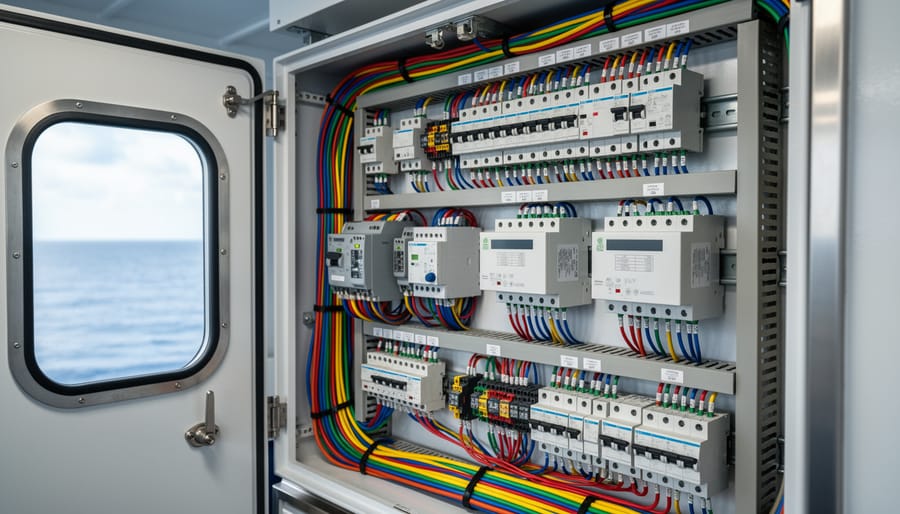
Your charge controller acts as the brain of the system. MPPT (Maximum Power Point Tracking) controllers extract 20-30% more power than cheaper PWM types, crucial when deck space limits how many panels you can fit. Size the controller to handle your total panel wattage plus 25% headroom for future expansion. Mount it in a ventilated location away from direct sun and spray. The engine room might seem convenient, but excessive heat reduces controller lifespan.
Wiring deserves equal attention. Marine-grade tinned copper cable resists corrosion, and proper gauge sizing prevents voltage drop that wastes power. A 10-foot run from panels to controller using 10 AWG wire keeps losses under 3% for most yacht systems. Secure all cables with UV-resistant zip ties, keeping them away from sharp edges and moving parts.
If you’re comfortable with electrical work and have installed systems on land, basic yacht solar is manageable. But penetrating the deck, running cables through bulkheads, or integrating with existing electrical systems calls for professional help. A marine electrician knows how to seal penetrations so they won’t leak five years later when you’re offshore. The installation cost hurts less than repairing water damage or dealing with electrical fires at sea.
Real Yacht Owners Share Their Solar Success Stories
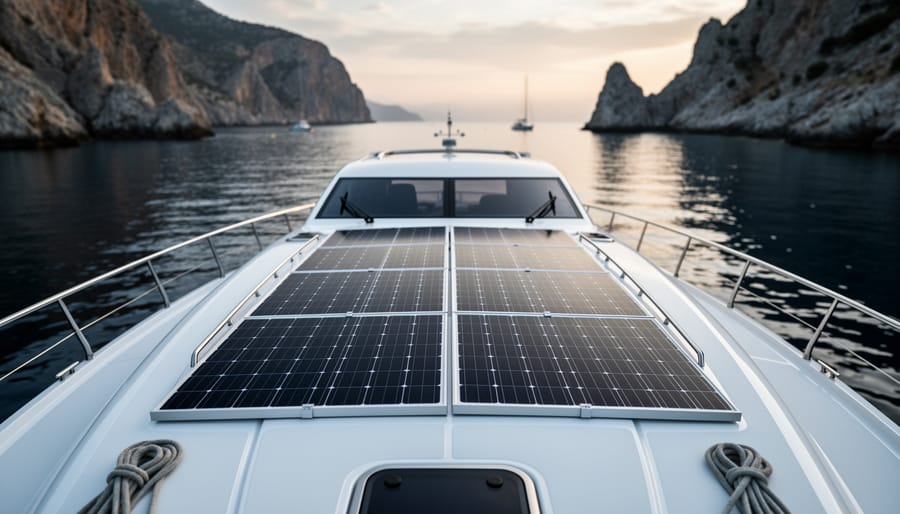
Sarah’s 42-foot catamaran transformation started with a simple goal: eliminate the constant drone of her generator during extended Caribbean cruises. She installed four 120-watt rigid panels across her hardtop, paired with a quality charge controller. “The silence was immediate and glorious,” she says. “We now run our navigation systems, refrigeration, and even a small watermaker entirely on solar during daylight hours.” Her biggest challenge came from underestimating wire gauge requirements for her installation, which caused voltage drop issues until a marine electrician helped her upgrade. Her advice? “Don’t cheap out on the balance of system components. The panels are fantastic, but proper wiring and a good controller make the difference between frustration and freedom.”
Marcus converted his 38-foot cruising sailboat with a mix of three walkable panels flush-mounted on the deck and two flexible panels on the bimini. Living aboard full-time in the Pacific Northwest, he wasn’t sure solar would work in Seattle’s gray climate. “I was wrong to doubt it,” he admits. “Even on overcast days, I’m harvesting enough to keep our house bank topped off without running the engine.” The walkable panels solved his limited hardtop space while maintaining full deck functionality. His one regret was waiting so long to install, calculating he’s already saved over 200 engine hours in just 18 months.
Jennifer and Tom upgraded their 55-foot motor yacht with six high-efficiency panels after years of relying on shore power at marinas. “We wanted to anchor out more but our power demands seemed impossible without the generator,” Jennifer explains. Their solar setup now handles everything except air conditioning, letting them spend weeks at anchor in quiet coves. The panels paid for themselves faster than expected through reduced fuel consumption and marina fees. Their tip for others? “Calculate your actual power draw honestly before sizing your system, then add 20 percent capacity. That headroom gives you real confidence to explore.”
Maintaining Your Marine Solar Investment
Your solar panels are working around the clock in one of the harshest environments imaginable. A simple maintenance routine keeps them performing at peak capacity and protects your investment for years to come.
Saltwater leaves behind a corrosive residue that steadily reduces panel efficiency. Rinse your panels with fresh water after every voyage, paying extra attention if you’ve been through heavy spray. For a deeper clean, use a soft cloth or sponge with mild, non-abrasive soap. Never use harsh chemicals or pressure washers that can damage the protective coatings. Most yacht owners find that a quick rinse every few days and a proper wash monthly keeps panels producing at full capacity.
Your monthly routine should include these essential checks:
- Inspect all cable connections for corrosion, especially at junction points where moisture tends to accumulate
- Check mounting hardware for any signs of loosening from vibration or wind stress
- Look for physical damage like cracks, chips, or delamination around panel edges
- Monitor your charge controller display for any error codes or unusual voltage readings
- Verify that panels remain securely fastened with no movement under hand pressure
Your charge controller tells the story of system health. Consistently low output on sunny days signals a problem, whether it’s shading, dirt buildup, or a failing panel. Keep a simple log of daily peak output during similar conditions. A sudden 20% drop deserves investigation.
Most issues you’ll spot yourself during routine inspections. Call in a marine electrician when you see moisture inside a panel, burned or melted connections, persistent error codes, or output that doesn’t improve after cleaning. These problems rarely fix themselves and can damage batteries or other components if ignored.
Think of maintenance as a quick conversation with your system. Five minutes of attention every few weeks prevents the expensive repairs that come from neglect.
Solar panels on your yacht aren’t just about cutting fuel costs or reducing generator hours, though those benefits matter. They represent a fundamental shift in how you experience time on the water. With a properly sized system quietly charging your batteries, you gain the confidence to anchor longer in remote coves, power your essentials without calculation, and move through the world’s waterways leaving nothing behind but your wake.
The technology has matured beyond the experimental stage. Panels now routinely exceed 24% efficiency, controllers manage complex charging profiles automatically, and installation methods have been proven across thousands of cruising vessels. You don’t need to be an early adopter anymore. The learning curve that tripped up pioneers has been smoothed into straightforward decisions about wattage, mounting location, and system configuration.
What’s changing isn’t just the hardware. The community of yacht owners running on sunshine continues to grow, sharing real-world guidance and demonstrating that energy independence isn’t a compromise. It’s an upgrade that aligns with both practical seamanship and environmental stewardship.
Your next anchorage could be powered by the sun overhead instead of diesel in your tank. The panels are ready. The question is whether you’re ready to claim that freedom and sail toward a future where clean, quiet power becomes the new normal on the water.