A solar portable kit for your boat is a self-contained power system that combines foldable or rollable panels, a charge controller, and often battery storage in one package, typically delivering between 100 and 400 watts to keep electronics, navigation equipment, and cabin systems running without shore power or fuel. The right kit depends on three factors: your daily energy needs (measured in watt-hours), your available deck or Bimini space, and whether you need temporary setup flexibility or semi-permanent mounting.
For most cruisers and weekend sailors, portable solar kits solve the same problem: maintaining battery charge during anchoring or mooring without running a noisy generator or draining your house bank. Unlike fixed marine solar panels that require drilling and permanent installation, portable systems can be deployed in minutes, angled toward the sun for maximum efficiency, and stowed below when weather turns rough or you head to the marina.
The market has evolved significantly. Today’s kits feature waterproof junction boxes, corrosion-resistant connectors, and controllers smart enough to handle lithium, AGM, and gel batteries without manual switching. You’ll find options ranging from compact 100-watt briefcase-style units perfect for maintaining starter batteries on a small sailboat, to robust 400-watt fold-out arrays capable of powering refrigeration and electronics on a 35-foot cruiser.
This guide walks you through the critical buying factors, compares the main kit types available, provides sizing calculations for common boat scenarios, and highlights the mistakes that cost boaters time and money. By the end, you’ll know exactly which portable solar solution matches your vessel and cruising style.
What Makes a Marine Solar Kit Different
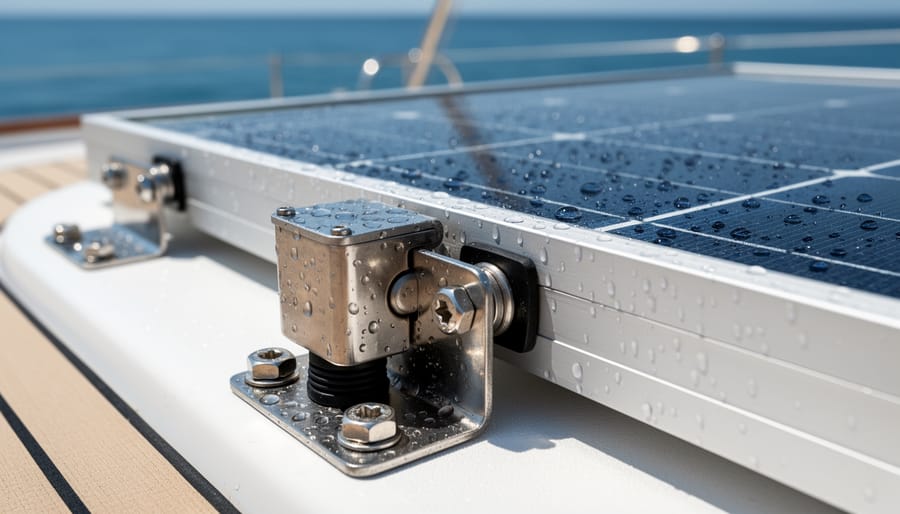
A solar kit designed for your boat isn’t just a land-based system in a different location, it’s engineered to survive conditions that would destroy typical residential panels within weeks. Marine environments demand equipment that can handle constant moisture exposure, corrosive salt spray, UV intensity reflected off water surfaces, and the continuous vibration and movement of a vessel underway.
Waterproofing represents the most obvious difference, but marine-grade protection goes beyond basic water resistance. Quality marine solar kits feature sealed junction boxes, fully encapsulated electronics, and corrosion-resistant connectors that prevent saltwater intrusion even during deck wash-downs or rough seas that send spray across your entire boat. The panels themselves need tempered glass strong enough to withstand impact from flying debris, dropped equipment, or the occasional misstep by crew moving around the deck.
Salt resistance extends to every component, from aluminum frames with marine-grade anodizing to stainless steel mounting hardware that won’t corrode and fail when you need your power system most. The charge controllers and battery management systems in marine kits incorporate conformal coating on circuit boards, a protective layer that shields electronics from the humid, salt-laden air present even on boats that never venture offshore.
Portability needs also differ significantly. While land-based systems stay permanently mounted, many boaters need panels they can deploy when anchored, then stow securely before getting underway. Marine kits typically include reinforced folding hinges, protective carrying cases, and mounting solutions that balance secure attachment with quick removal, all while maintaining electrical connections that won’t loosen from engine vibration or wave impacts transmitted through the hull.
Essential Features to Consider Before You Buy
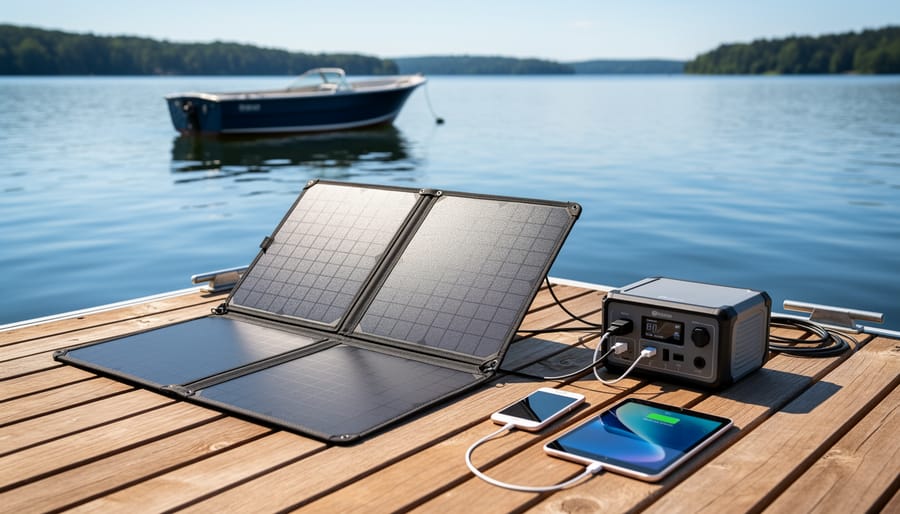
Choosing the right solar portable kit means balancing several critical factors against your specific boating needs. Start by calculating your daily power consumption, add up the watts used by navigation electronics, lights, refrigeration, pumps, and communication devices, then multiply by hours of use. A VHF radio drawing 5 watts over 12 hours needs 60 watt-hours daily, while an LED anchor light at 3 watts running all night adds another 36. These real numbers determine your minimum solar capacity, and most coastal cruisers discover they need 100-200 watts of panel output to maintain basic systems comfortably.
Panel efficiency directly affects how much deck space you’ll sacrifice for power generation. Modern monocrystalline panels convert 18-22% of sunlight into electricity, delivering more power per square foot than older polycrystalline designs. This matters enormously on boats where mounting area is precious. A high-efficiency 100-watt panel might measure just 3 feet by 2 feet, fitting neatly on a cabin top, while a lower-efficiency equivalent could be 30% larger.
Battery capacity and chemistry determine how much energy you can store for overnight use and cloudy days. Lithium iron phosphate (LiFePO4) batteries cost more upfront but deliver twice the usable capacity of lead-acid at half the weight, a crucial advantage on weight-sensitive sailboats. A 100Ah lithium battery provides roughly 90Ah of usable power without damage, while a similar lead-acid unit safely delivers only 50Ah before risking permanent capacity loss.
The charge controller regulates power flow from panels to batteries, preventing overcharging and optimizing collection. MPPT (Maximum Power Point Tracking) controllers extract 20-30% more energy than basic PWM types, particularly valuable during marginal light conditions when every watt counts. Quality controllers also protect against reverse current drain at night and handle voltage fluctuations from engine charging.
Expandability matters because boaters typically add devices over time. Can you connect additional panels later? Does the controller handle higher input? Before you choose yacht panels verify compatibility with future upgrades rather than replacing the entire system when adding a watermaker or electric winch.
Mounting flexibility affects both performance and practicality. Permanently mounted rigid panels maximize collection but commit valuable deck space. Folding portable panels stow below when not needed, perfect for occasional sailors, though they require setup and offer less consistent charging. Consider your sailing style, weekend warriors value portability, while liveaboards prioritize permanent installation efficiency.
Types of Marine Solar Kits Compared
Compact Portable Folding Kits
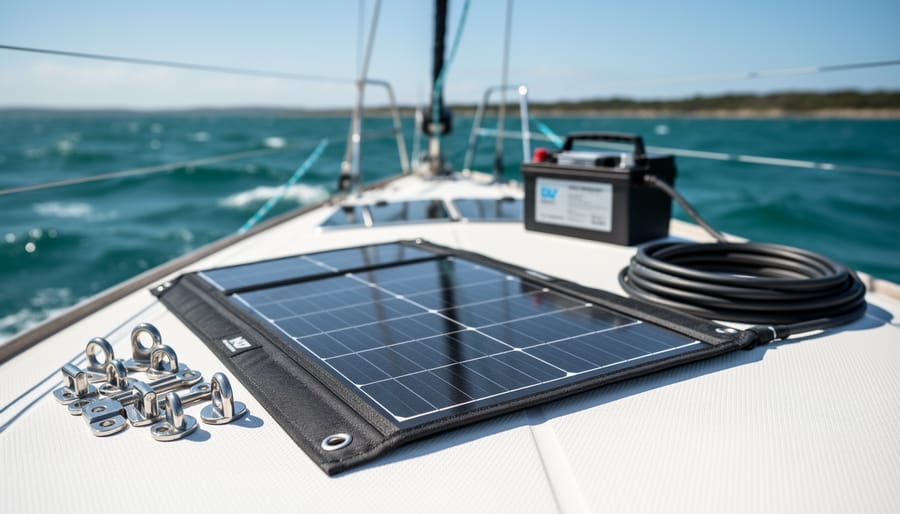
Compact folding solar kits are the Swiss Army knives of marine power, lightweight, versatile, and designed to stow away when not needed. These typically range from 50 to 200 watts, with panels that fold into briefcase-sized cases you can tuck under a seat or in a cuddy cabin.
For dinghy sailors, weekend cruisers, and those with limited deck space, these kits shine. They weigh as little as 10 pounds and deploy in seconds, letting you angle them toward the sun regardless of your boat’s orientation. You’re not committed to permanent mounting holes in your pristine gelcoat, and you can take the kit home for winter storage or use it for camping trips.
The trade-offs are real, though. Lower wattage means they’ll keep your phone, GPS, and fishfinder running but won’t power a cabin refrigerator or electric windlass for long. They’re also vulnerable to being knocked over in choppy conditions and typically lack the robust weatherproofing of permanently mounted systems.
These kits work brilliantly for maintaining batteries during storage, powering essential electronics on day sails, or supplementing your alternator charging on occasional overnight trips. They won’t transform your boat into an off-grid powerhouse, but they’ll keep you connected and charged when it matters most.
Mid-Size Semi-Permanent Systems
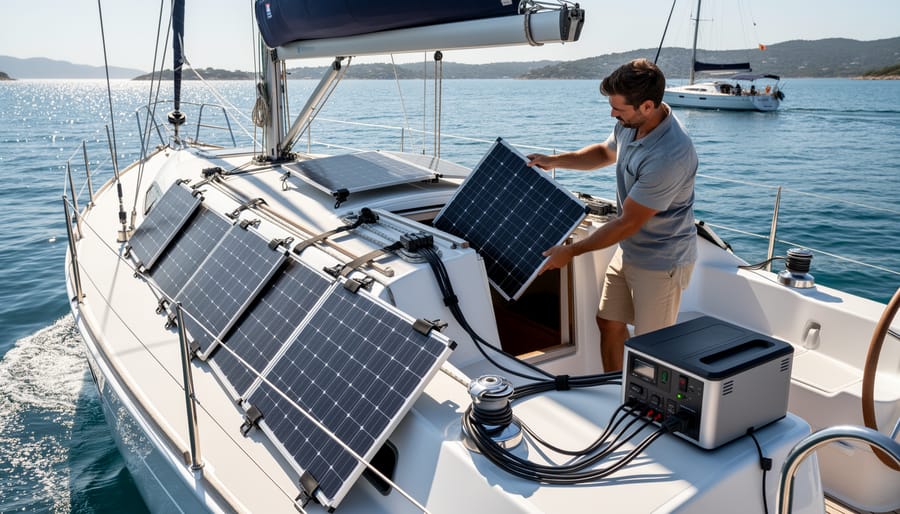
Mid-size semi-permanent systems strike the sweet spot for weekend cruisers and regular sailors who need reliable power without committing to a full hard-mounted installation. These kits typically range from 100 to 200 watts and feature rigid panels with quick-release mounting brackets that let you secure them during passages but remove them for storage or repositioning to catch optimal sun angles.
Unlike compact folding units, these systems include proper marine-grade charge controllers and often come with pre-wired battery connections, making them genuinely plug-and-play once you’ve decided on mounting locations. The panels themselves are built tougher, with reinforced aluminum frames and tempered glass faces that handle spray, occasional foot traffic, and the vibrations of underway operation far better than their portable cousins.
What sets these apart is their ability to generate meaningful power day after day. A 150-watt semi-permanent kit can typically maintain your house batteries during a full cruising season, running navigation electronics, cabin lights, and a small refrigerator without constantly monitoring your charge state. You’re getting about 70% of what a permanent installation delivers, with the flexibility to adjust placement as seasons change or to remove panels entirely during hurricane season or long-term storage.
Complete Power Station Kits
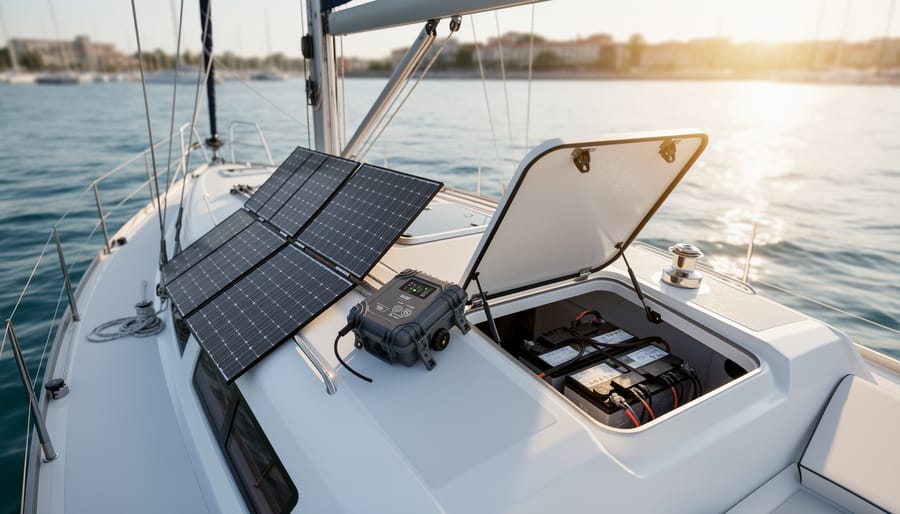
Complete power station kits represent the most robust solar solution for serious cruisers and liveaboard sailors who need reliable off-grid capability. These comprehensive systems bundle solar panels, lithium battery banks, charge controllers, and inverters into coordinated packages designed to replace or significantly reduce generator use.
What sets these kits apart is their ability to power demanding marine systems, refrigeration, microwaves, water pumps, navigation electronics, for extended periods without shore power or engine charging. You’re typically looking at systems starting around 1,000 watts of solar capacity paired with 200+ amp-hour lithium batteries, expandable to meet greater demands.
These systems shine for sailors planning extended passages, living aboard full-time, or cruising remote waters where shore power isn’t accessible for weeks at a stretch. The integrated components eliminate compatibility guesswork, and many include monitoring systems that let you track energy production and consumption in real time.
The investment is substantial, often several thousand dollars, but for committed cruisers, the freedom from fossil fuels and the quiet, sustainable power generation transforms the liveaboard experience. Many sailors report running air conditioning, making fresh water, and powering all electronics entirely from solar after installing these comprehensive systems.
Matching Kit Size to Your Boat’s Energy Needs
Start by listing what’s actually running on your boat. A typical day-sailing setup might draw 30-50 watts continuously for navigation lights and a VHF radio, while a weekend cruiser with a fridge adds another 40-60 watts averaged over 24 hours. Liveaboards often need 100-200 watts sustained to cover refrigeration, lighting, water pumps, and electronics charging.
Here’s what common marine equipment actually consumes:
- LED cabin lights: 1-3 watts each
- Navigation lights (LED): 5-10 watts total
- VHF radio (standby): 0.5-2 watts
- 12V marine refrigerator: 40-60 watts average (cycles on/off)
- GPS chartplotter: 3-8 watts
- Autopilot: 15-40 watts when active
- Phone/tablet charging: 10-20 watts
- Water pressure pump: 40-60 watts when running
Add up what runs simultaneously during your typical day, then multiply by hours of use. A sailor running navigation electronics for eight hours, lights for four hours, and a fridge continuously needs roughly 600-800 watt-hours daily. Size your solar kit to replace that energy with a 20-30% buffer for cloudy conditions and battery inefficiency.
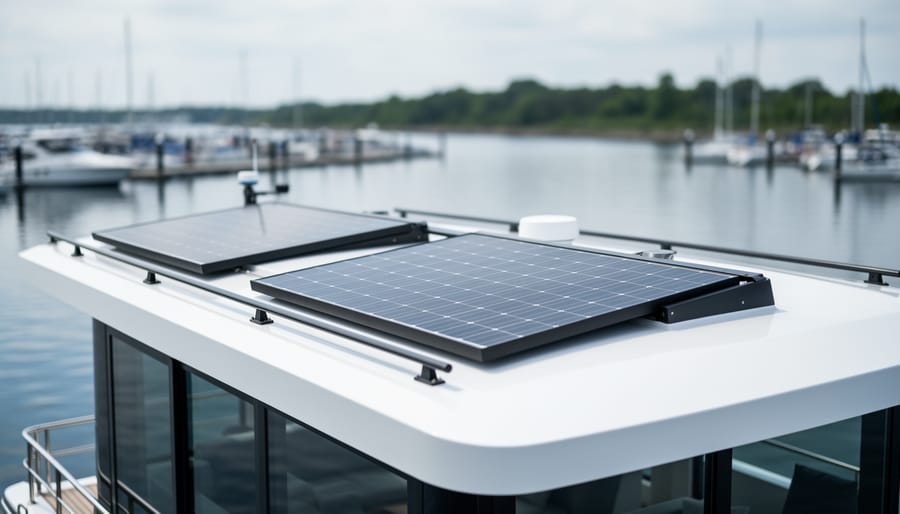
For a small sailboat with basic electronics, a 100-watt portable kit handles essentials. Weekend cruisers with refrigeration need 200-300 watts. Extended passages or liveaboard situations demand 400+ watts, often where houseboat panel options become relevant for permanent installations alongside portable expansion.
Consider your worst-case scenario, not ideal conditions. If you typically motor-sail and can charge batteries while running the engine, you’ll rely less heavily on solar. Pure sailors need larger arrays. Three overcast days in a row shouldn’t leave you powerless, so factor in enough capacity to maintain critical systems even when the sun doesn’t cooperate.
Our Top Recommendations for 2026
When you’re ready to choose a solar portable kit for your boat, the right solution depends on three core factors: your boat’s size and type, how you actually use it, and what you’re willing to invest. Here’s how different boating scenarios align with kit capabilities.
For weekend sailors on smaller boats under 25 feet, compact folding kits in the 100-200 watt range work well. These typically handle essentials like navigation electronics, VHF radio, and LED cabin lights without overwhelming your budget. Look for kits with sturdy aluminum frames, integrated kickstands for angle adjustment, and waterproof junction boxes. Quality units in this category include a compatible charge controller and MC4 connectors. Budget around $250-$500 for reliable entry-level systems that won’t let you down on a weekend cruise.
Mid-size cruising sailboats between 28-40 feet benefit from semi-permanent systems in the 300-500 watt range. These handle refrigeration, autopilot, chartplotters, and extended anchor stays without shore power. The best setups use monocrystalline panels with marine-grade corrosion resistance, MPPT charge controllers for efficiency, and expandable design so you can add capacity later. Expect to invest $800-$1,500 for systems that genuinely support serious cruising.
For liveaboards and extended offshore cruising on larger vessels, complete power station kits with 600+ watts and integrated lithium battery banks make sense. These provide true energy independence, running everything from watermakers to laptops. Prioritize systems with advanced monitoring, multiple charging inputs (solar plus shore/alternator), and robust warranties. Budget $2,000-$4,000, but consider it against years of marina fees and fuel costs.
Budget shoppers should focus on proven panel technology over flashy features. A straightforward 200W kit with a quality MPPT controller beats a 300W bargain setup with a cheap PWM controller. The controller directly impacts how much power you actually capture, especially in partial shade or variable conditions common on boats.
Common Mistakes to Avoid When Buying Marine Solar Kits
The most common pitfalls stem from underestimating the marine environment’s unique demands and the realities of solar power generation at sea. Learning from these mistakes now can save you hundreds in replacement equipment and frustrating afternoons troubleshooting.
Many boaters purchase systems based solely on wattage numbers without considering their actual daily energy consumption. A 100-watt panel sounds impressive until you realize your refrigerator alone draws 50 watts continuously. Before buying, track your power usage for a typical day or weekend aboard. List every device you’ll run, note its amp draw, and calculate total watt-hours needed. This honest assessment prevents discovering your new solar kit only covers half your requirements after you’ve already mounted it.
Choosing non-marine rated components presents another expensive lesson. Standard solar equipment designed for RVs or homes can’t withstand salt spray, constant humidity, and vibration from wave action. Marine-grade panels use corrosion-resistant frames, sealed junction boxes, and UV-stable materials that last years longer in coastal conditions. The price difference between standard and marine-rated gear is modest compared to replacing corroded equipment.
- Skimping on charge controller quality to save fifty dollars, then dealing with overcharged batteries or inefficient charging
- Ignoring panel placement and shading patterns, reducing actual output by thirty to fifty percent
- Expecting full rated power on overcast days when output typically drops to ten to twenty percent
- Buying incompatible components that can’t communicate with your existing battery management system
- Underestimating installation complexity and skipping proper marine-grade wiring and fusing
Perhaps the biggest mistake is expecting solar to match shore power performance. Solar excels at extending time between charging and reducing generator runtime, not eliminating all other power sources. Setting realistic expectations about what your kit can deliver, especially during consecutive cloudy days, keeps you satisfied rather than disappointed with your investment in cleaner energy.
Installation and Setup Considerations
Most compact and mid-size marine solar kits are genuinely DIY-friendly, especially if you’re comfortable working with basic electrical connections. You’re typically connecting panels to a charge controller, then to your boat’s battery bank, straightforward tasks that don’t require specialized expertise. Manufacturers design these systems with boaters in mind, often including pre-wired components and clear color-coded terminals.
That said, integrating a complete power station or tying into complex existing electrical systems warrants professional installation. If your boat has sophisticated electronics, multiple battery banks, or you’re uncertain about proper fusing and wire sizing, consult a marine electrician. The modest installation cost prevents expensive mistakes and ensures your warranty remains valid.
Mounting location dramatically affects performance. Panels need unobstructed sunlight throughout the day, which means avoiding shade from masts, booms, radar arches, and bimini tops. Hardtop surfaces, stern railings, and davits often provide ideal mounting platforms on motorboats. Sailboat owners frequently mount panels on deck, dodgers, or specially fabricated arch frames that clear the boom swing. Portable folding kits offer flexibility here, you can position them for optimal sun exposure regardless of your boat’s orientation.
Wiring represents the most critical safety consideration. Use marine-grade tinned copper wire sized appropriately for the amperage and cable length to prevent voltage drop and overheating. All connections need waterproof heat-shrink covering or marine-grade terminal blocks rated for the environment. Install proper inline fusing between the charge controller and battery to protect against short circuits. Never run solar wiring through bilge areas where it might contact standing water.
Integration with your existing battery system requires matching voltage, most marine solar kits work with standard 12V systems, though larger boats may use 24V or 48V configurations. Your charge controller must accommodate your battery chemistry, whether flooded lead-acid, AGM, gel, or lithium. Modern controllers often support multiple battery types through selectable charging profiles, but verify compatibility before purchasing.
Frequently Asked Questions
Will saltwater damage my portable solar kit?
Quality marine-grade solar kits are specifically designed to withstand saltwater exposure with corrosion-resistant frames, sealed junction boxes, and waterproof connectors. Regular freshwater rinses after sailing help extend their lifespan even further.
How well do solar panels work on cloudy days?
You’ll still generate power on overcast days, typically 10-25% of full capacity depending on cloud thickness. This is why proper sizing matters, build in buffer capacity for less-than-ideal conditions rather than calculating based solely on peak sun hours.
Can I expand my system later as my power needs grow?
Most quality marine solar kits are designed for expansion, allowing you to add panels, increase battery capacity, or upgrade charge controllers. Check that your initial charge controller is rated to handle additional panels before purchasing, as this determines future expansion possibilities.
What maintenance do marine solar kits require?
Maintenance is minimal, rinse panels with fresh water to remove salt and debris, check connections periodically for corrosion, and monitor battery health. Panels themselves have no moving parts and typically need only basic cleaning to maintain efficiency.
How long will my solar panels last in a marine environment?
Marine-grade panels typically carry 25-year warranties and often outlast that timeframe with proper care. When they eventually do reach end-of-life, understanding how PV recycling works helps you dispose of them responsibly rather than adding to landfill waste.
Can I really run everything on my boat with solar power alone?
It depends on your energy consumption and battery storage capacity. Many sailors successfully run navigation electronics, lighting, refrigeration, and communications purely on solar, though high-draw appliances like air conditioning or electric cooking typically require engine charging or shore power as backup.
These questions reflect what we hear most often from boaters considering their first solar installation. The answers might surprise you, solar technology has advanced considerably, making systems more reliable and capable than many people expect. Still, setting realistic expectations from the start leads to much greater satisfaction than overselling capabilities. Your specific situation depends on your boat size, typical cruising patterns, and how you use power onboard, which is why thoughtful planning beats rushing into a purchase based solely on wattage numbers or price.
Choosing a solar portable kit for your boat represents more than an equipment upgrade, it’s a meaningful step toward cleaner, quieter time on the water. You’re joining a growing community of boaters who’ve discovered that sustainable power doesn’t mean compromising on convenience or capability. Solar technology has matured to where it reliably meets real-world marine needs, from weekend cruising to extended offshore passages.
The environmental advantages extend throughout the product lifecycle. Solar kits eliminate fuel consumption and engine noise, reducing your carbon footprint while enhancing your experience of nature. Modern solar panels are designed with panel recycling in mind, ensuring responsible end-of-life management as part of the broader sustainability picture.
Beyond the ecological impact, you gain practical freedom. Your boat becomes self-sufficient, drawing power from the sun rather than searching for shore power or running generators. You’ll reduce maintenance demands, eliminate fuel costs for auxiliary charging, and enjoy peaceful anchorages without engine rumble.
Getting started doesn’t need to feel overwhelming. Our factory-trained staff understand the unique challenges of marine solar installations and can help match the right kit to your specific boat and usage patterns. Whether you’re powering basic navigation electronics or planning full off-grid capability, there’s a solution that fits your needs and budget.
The best time to embrace solar power for your boat is now, the technology works, the options are proven, and the water’s waiting.
Our product links may earn us a commission — the price you pay stays exactly the same.