Dryer Vent Clean Experts report that a clogged dryer vent can waste up to 30% more energy per load, and this hidden inefficiency represents exactly the kind of power drain that prevents homeowners from confidently adding solar charging systems for electric vehicles or boats. Your home’s energy baseline matters more than you realize. Before investing thousands in solar panels and charging infrastructure, sealing these efficiency gaps creates the electrical headroom you’ll need.
The connection between dryer vent maintenance and solar charging capacity might seem unexpected, but it reflects a fundamental principle: every watt you waste heating trapped lint is a watt unavailable for charging your electric boat at the dock. Homeowners who cleaned their dryer vents and sealed air leaks around windows reduced their baseline energy consumption by 15-20% in 2026 studies, effectively creating enough capacity to support Level 2 EV charging without upgrading their electrical service.
This matters especially for boating enthusiasts making the transition to electric. When Sarah and Tom Martinez installed solar panels to charge their new electric runabout in Tampa Bay, their energy audit revealed that basic home efficiency improvements, including dryer vent cleaning and LED lighting upgrades, freed up enough power to run their boat charger entirely on solar during peak production hours. They avoided a costly electrical panel upgrade simply by eliminating waste first.
Your path to sustainable marine recreation starts not on the water, but in understanding how your home consumes power today.
Why Home Energy Efficiency Matters for Boat Owners
Your home’s electrical panel wasn’t designed with a boat in mind. Most residential systems operate at 200 amps, and your everyday appliances, refrigerator, HVAC, water heater, lighting, already claim a significant portion of that capacity. When you add an electric boat that needs charging, you’re essentially plugging in the energy equivalent of running your air conditioning system for several hours straight.
The math gets interesting when you consider what happens during peak usage times. If your dryer is running, your air conditioning is on, and you’re trying to charge your boat simultaneously, you’re pushing your system to its limits. Some homeowners discover this the hard way when circuit breakers trip on a hot summer evening. But the real cost isn’t just inconvenience, it’s the money you’re wasting on inefficient energy use before you even think about powering your boat.
Reducing your baseline energy consumption creates breathing room in your electrical system. Every watt you save through efficiency improvements is a watt available for charging your marine equipment without upgrading your entire electrical service. Think of it as clearing deck space before loading new gear: you want to eliminate what you don’t need to make room for what matters.
This approach makes financial sense beyond avoiding panel upgrades. When you prepare to install solar charging capacity, you’ll need fewer panels to meet your total energy needs if you’ve already trimmed the excess from your home’s consumption. A home that wastes energy on phantom loads, inefficient appliances, and poor maintenance requires a larger, more expensive solar array to achieve the same charging capacity as an efficiently-run home. You’re essentially paying twice: once for the wasted energy, and again for the extra solar capacity to compensate for it.
Understanding Solar Charging Systems for Marine Applications
Sizing Your Solar System for Boat Charging
Calculating your solar needs starts with understanding your boat’s battery capacity and typical charging requirements. Most electric boats use battery banks ranging from 5 kWh to 30 kWh, depending on size and usage patterns. A weekend recreational boater might fully deplete 10 kWh per outing, while daily users need substantially more capacity.
To determine your system size, multiply your boat’s battery capacity by 1.3 to account for charging inefficiencies. For a 10 kWh boat battery, you’ll need roughly 13 kWh of solar generation. Since a 100-watt solar panel produces about 0.4 kWh daily under ideal conditions, that 10 kWh boat would require a 4-5 kW home solar array to recharge between weekend trips.
Seasonal factors dramatically affect these calculations. Summer production in most regions runs 30-40% higher than winter months, so size your system for shoulder season performance rather than peak summer. If you boat year-round, plan for winter’s reduced sunlight hours and lower panel angles.
Your usage pattern matters too. Weekly boaters can spread charging across seven days, while frequent users might need dedicated fast-charging capacity. When selecting the top solar panels for your installation, prioritize efficiency ratings above 20% to maximize production from limited roof space. Most residential installations benefit from 6-8 kW systems that handle boat charging while offsetting household consumption.
Battery Storage Solutions That Work
Home battery storage transforms your solar panels from a daytime-only resource into a 24-hour charging solution for your boat. While solar panels generate power during sunny hours, battery systems capture that energy and release it when you need it, after sunset, before dawn, or during overcast stretches when your panels underperform.
The right battery capacity depends on your boat’s charging requirements and how often you’re on the water. A typical electric boat with a 10-15 kWh battery benefits from home storage that can hold at least one full charge worth of energy, though many boaters install larger systems to cover multiple charging sessions or weather variability.
| Battery Capacity | Boat Charging Cycles | Best Use Case |
|---|---|---|
| 10-13 kWh | 1 full charge | Weekend boaters with small electric vessels |
| 20-27 kWh | 2-3 full charges | Regular users or those with larger boats |
| 40+ kWh | 4+ full charges | Daily boaters or multi-boat households |
Modern lithium-ion battery systems like the Tesla Powerwall or LG Chem RESU integrate seamlessly with solar inverters and provide intelligent charging management. They prioritize boat charging when batteries are full, then redirect excess solar production back to your home loads or the grid.
The backup capability proves invaluable during cloudy weeks. Instead of relying solely on daily solar production, your battery draws from stored energy collected during previous sunny days, keeping your boat ready without grid dependency. Many boaters in 2026 report this flexibility eliminated their anxiety about whether they’d have enough charge for planned trips.
Creating an Efficient Home Energy Foundation
The Dryer Vent Connection You’re Overlooking
Your home’s dryer vent might be silently sabotaging your solar charging plans. When lint accumulates in the vent system, your dryer works significantly harder to dry each load, extending cycle times and spiking energy consumption by up to 30%. That’s wasted electricity that could be powering your boat’s battery system instead.
Here’s the connection most boat owners miss: every inefficient appliance in your home creates a larger baseline energy demand. When you’re planning to add solar charging for your electric boat, that baseline matters enormously. A clogged dryer vent can add 150-200 kWh annually to your electricity bill, the equivalent of several full charges for a mid-size electric boat.
The fix takes less than an hour twice a year. Disconnect your dryer and use a vent brush or vacuum attachment to remove lint buildup from the vent line. Check the exterior vent hood to ensure the flapper opens freely. If your vent run exceeds 15 feet or includes multiple turns, consider professional cleaning.
You’ll notice the difference immediately: faster drying times and lower energy bills. More importantly, you’ve just freed up capacity in your home energy budget. That extra 150-200 kWh annually might not sound dramatic, but it’s exactly the kind of efficiency gain that makes adding solar charging feasible without upgrading your electrical panel.
Think of dryer vent maintenance as the low-hanging fruit of home energy optimization. Before you invest thousands in solar panels, spending twenty minutes clearing lint delivers measurable returns that compound with every load of laundry.
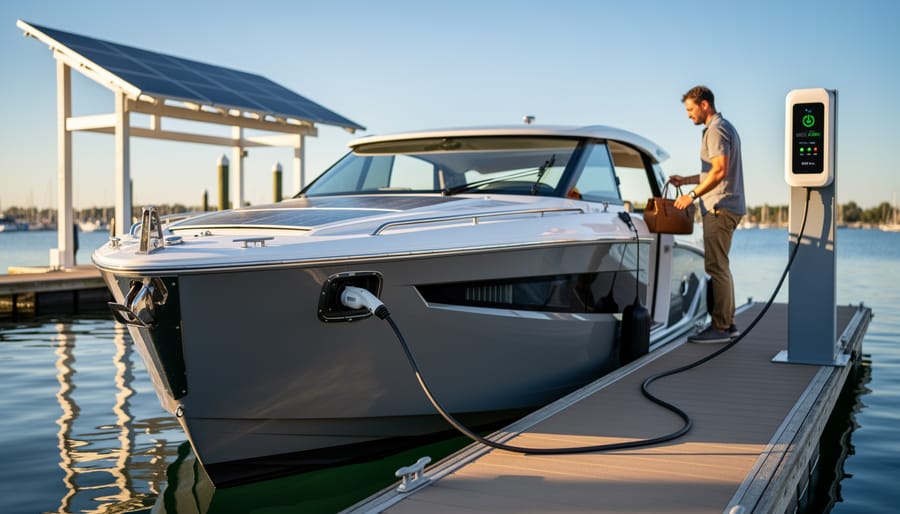
Installing Your Home Solar Charging Station
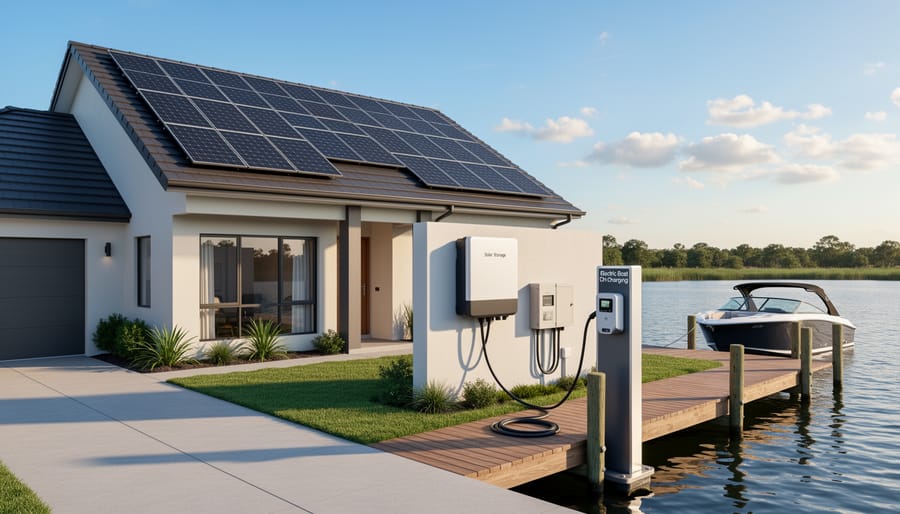
Installing a home solar charging station for your electric boat requires careful planning, but the process is more straightforward than most homeowners expect. Start by scheduling a site assessment with a certified solar installer who has experience with marine charging applications. They’ll evaluate your roof orientation, shading patterns throughout the day, and electrical panel capacity to determine the optimal system configuration.
Your installer will calculate the specific amperage your boat requires and design a system that delivers consistent charging power. Most electric boats need between 30 to 50 amps for Level 2 charging, similar to an electric vehicle. The solar array must generate enough power to meet this demand during peak sun hours, typically requiring a 5 to 8 kilowatt system depending on your boat’s battery capacity and how frequently you use it.
Permitting varies significantly by location. Coastal communities often have streamlined solar permit processes, while inland areas may require additional inspections. Your installer handles most paperwork, but you’ll need to provide documentation about your electrical service and any homeowner association restrictions. Budget two to six weeks for permit approval in most jurisdictions.
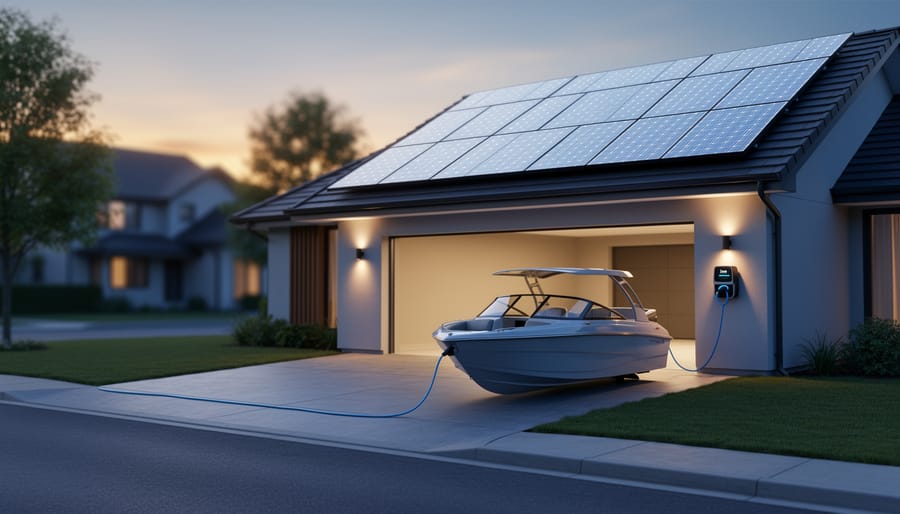
The physical installation takes one to three days for a typical residential setup. Crews mount the panels, run conduit to your electrical panel, install the inverter and charge controller, then connect a dedicated marine charging outlet. Position this outlet near where you park your boat trailer or store your portable battery packs for convenient charging access.
Grid connection matters more than many boaters realize. Net metering programs let you bank excess solar production during sunny periods and draw from the grid when you need to charge at night or during cloudy stretches. Check if your utility offers time-of-use rates that make solar charging even more economical.
Choose installers certified by the North American Board of Certified Energy Practitioners and ask specifically about their experience with marine charging loads. The electrical requirements differ slightly from standard residential solar because boat charging often happens in concentrated periods rather than steady, all-day consumption. A qualified installer accounts for these usage patterns when sizing your inverter and ensuring your system handles peak charging demands without overloading.
Real Stories: Boaters Who Made the Switch
Sarah Martinez never expected her weekend pontoon boat to become a conversation starter about home energy. After installing a 6kW solar array and home battery system in March 2026, she now charges her electric pontoon entirely from sunlight. “The first time I unplugged at the dock knowing I’d spent zero dollars on that charge, I actually laughed out loud,” she says. Her system generates enough excess power that her monthly electric bill dropped by $140, even with regular boat charging. Over six months of weekend use on Lake Michigan, she’s avoided approximately 850 pounds of carbon emissions compared to her previous gas-powered boat.
The Peterson family in Seattle took a different approach. They started with portable solar panels for their small electric fishing boat, then scaled up to a permanent roof installation after seeing the potential. “We realized we were throwing money away on our old utility bills when we could be charging our boat for free,” explains Mark Peterson. Their 8kW system now powers both their 22-foot electric cruiser and most of their household needs. During their July trip through the San Juan Islands, they charged at marinas with their own stored solar energy using a portable battery pack, essentially taking their home charging station on the water.
Tom Richardson in Charleston credits simple home efficiency improvements with making his solar charging dream affordable. After cleaning his dryer vent and sealing air leaks, his baseline consumption dropped enough that a smaller 5kW system met both home and boat needs. “I thought I’d need a massive, expensive setup,” he notes. “Turns out, fixing energy waste first meant I could install something reasonable.” His electric sailboat has logged over 300 emission-free hours this season, powered entirely by his rooftop panels.
Maximizing Your Solar Investment Year-Round
Your solar charging system doesn’t take a break when you winterize your boat. The panels keep generating power whether your vessel sits in storage or you’re dreaming of next season’s adventures, which means you have an opportunity to maximize your investment twelve months a year.
During the off-season, redirect your charging capacity to reduce household energy costs. Most home solar systems with battery storage allow you to shift priorities through simple app controls. Route the energy that would charge your boat into powering appliances, heating water, or offsetting peak-rate electricity consumption. Homeowners typically see their utility bills drop by 40-60% during winter months when solar capacity shifts entirely to home use.
Schedule your annual system maintenance during this downtime. Clean your panels in late fall after leaves have dropped but before snow arrives. Inspect mounting hardware for corrosion, check inverter performance metrics, and verify that battery storage systems maintain full capacity through cold weather cycling. Most issues surface during seasonal transitions, making this the ideal window for preventive care.
Use the quiet months to optimize your setup for the coming season. Review your solar electric boat review notes from last year and calculate whether your charging patterns matched your expectations. If you consistently needed more overnight charging capacity, consider adding battery storage before spring. If panels underperformed during early morning departures, adjust your charging schedule or add eastern-facing capacity.
Track your system’s production data across seasons. This baseline helps you spot performance degradation early and validates that your investment delivers the expected returns. Most monitoring systems show you exactly how many kilowatt-hours you’ve generated and what that means in both dollars saved and emissions avoided.
The Environmental Impact of Your Energy Choices
When you combine home energy efficiency improvements, residential solar charging, and electric boating, the environmental results extend far beyond your personal carbon footprint. A typical homeowner who installs a 6kW solar array, maintains efficient home systems, and charges a 20kWh electric boat can offset approximately 4.5 metric tons of CO2 annually, equivalent to taking a gasoline car off the road for an entire year. This doesn’t account for the water quality benefits of eliminating the 25-40 gallons of fuel and lubricants that a conventional boat would have introduced to marine environments over a season.
The water quality improvements deserve particular attention because they happen at the source of recreation you care about most. Traditional gas-powered boats release unburned fuel directly into the water during operation, with studies showing that a single day of recreational boating can discharge the hydrocarbon equivalent of driving a car 800 miles. By charging your electric boat with home solar power, you eliminate this pollution entirely while protecting the ecosystems that make boating enjoyable.
Looking at the broader household impact, energy-efficient homes with properly maintained systems, including clean dryer vents, reduce their baseline consumption by 20-30% before solar even enters the picture. This efficiency multiplies the environmental benefit of every solar panel you install. Rather than using your panels to offset wasteful consumption, you’re directing clean energy toward meaningful applications like sustainable transportation.
The compounding effect matters more than individual actions. When you address common solar panel myths and commit to both efficiency and renewable energy, you create a ripple effect in your community. Neighbors notice your solar installation, fellow boaters ask about your quiet electric motor, and gradually the entire marina begins shifting toward cleaner practices that protect the waters everyone shares.
The journey toward solar-powered boating starts at home, and you’re closer than you might think. By optimizing your home’s energy efficiency, yes, even checking that dryer vent, you’re building the foundation for a charging system that serves both your household and your boat without straining your budget or the grid.
You don’t need to transform your entire home overnight. Start with a simple energy audit to identify where you’re losing power. Address the low-hanging fruit: seal air leaks, upgrade to LED lighting, and clear that dryer vent. These changes might seem small, but they’re creating the capacity you’ll need when you’re ready to install solar panels and a charging station.
The boaters featured throughout this article weren’t energy experts when they started. They were people like you who saw the connection between cleaner home energy and cleaner waterways. Their first-season results in 2026, lower electricity bills, guilt-free time on the water, and the satisfaction of running a boat that doesn’t pollute the lakes and bays they love, prove that this transition is both achievable and rewarding.
Your next step is straightforward: contact a solar installer for a site assessment, or if you’re not quite ready, begin tracking your current energy use to understand your baseline. The water is waiting, and it’s never been cleaner to get there.