Choosing the right portable solar panel for your boat comes down to three essential decisions: selecting between rigid, semi-flexible, or foldable designs; matching wattage to your actual daily energy consumption; and ensuring the panel can withstand saltwater, UV exposure, and constant motion. Most boaters overestimate their power needs or underestimate the marine environment’s toll on equipment, leading to panels that either underperform or fail prematurely.
The marine setting demands more from solar technology than a rooftop installation ever will. Corrosion from salt spray, temperature swings from sun-baked decks to cool nights, and the physical stress of wind and waves mean your panels need features that land-based models simply skip. You’re not just buying watts. You’re investing in durability, portability, and the freedom to extend your time on the water without idling engines or rationing power.
What makes this choice empowering is that the right portable solar setup transforms how you experience boating. Instead of planning trips around fuel stops or battery life, you gain genuine autonomy. One sailor we spoke with added a 200-watt foldable panel to her 32-foot cruiser and now runs her refrigeration, navigation electronics, and cabin lights entirely from the sun during multi-week coastal passages. She hasn’t run her generator in over a year.
This guide walks you through panel types, capacity calculations specific to marine loads, and the features that separate weekend-warrior gear from true offshore equipment. We’ll also cover common sizing mistakes and help you think beyond the initial purchase to considerations like panel recycling when your system eventually reaches end of life. By the end, you’ll know exactly what to look for and why it matters on the water.
What Makes a Solar Panel Right for Marine Conditions
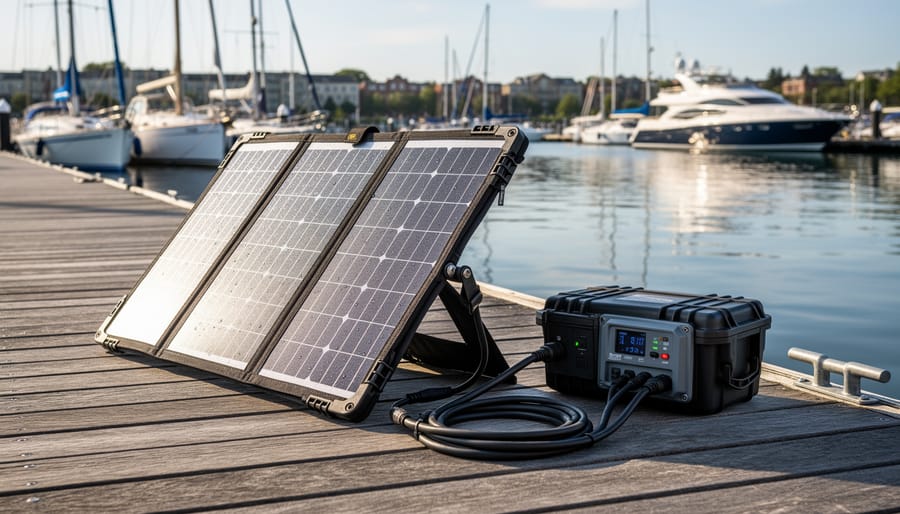
The ocean isn’t forgiving. Saltwater spray eats through electronics that weren’t designed for it, while unrelenting sun beats down on equipment hour after hour. Your solar panel faces conditions that would destroy a typical rooftop installation within months.
Marine-grade solar panels differ from residential ones in three critical ways. First, they’re built to resist saltwater corrosion. Quality marine panels use anodized aluminum frames and stainless steel hardware rather than standard materials that rust and deteriorate. The panel edges are sealed to prevent moisture from creeping into the circuitry, something that happens quickly when salt spray and humidity team up.
Second, marine panels handle UV exposure far better. Land-based panels rarely see the reflected UV bouncing off water, which effectively doubles their sun exposure. Marine panels use UV-resistant coatings and tempered glass that won’t yellow, crack, or lose efficiency after a season in harsh sunlight.
Movement matters too. Boats flex, rock, and vibrate constantly, forces that can crack rigid connections or loosen mounting points. Marine panels incorporate flexible mounting systems and shock-resistant construction that absorbs this movement rather than fighting it.
Waterproof ratings tell you how much exposure a panel can handle. IP67-rated panels can survive temporary submersion, while IP65 offers solid protection against spray and rain. For most boaters, IP65 provides sufficient protection, but if you’re mounting panels low on the deck where waves might wash over them, IP67 gives extra peace of mind.
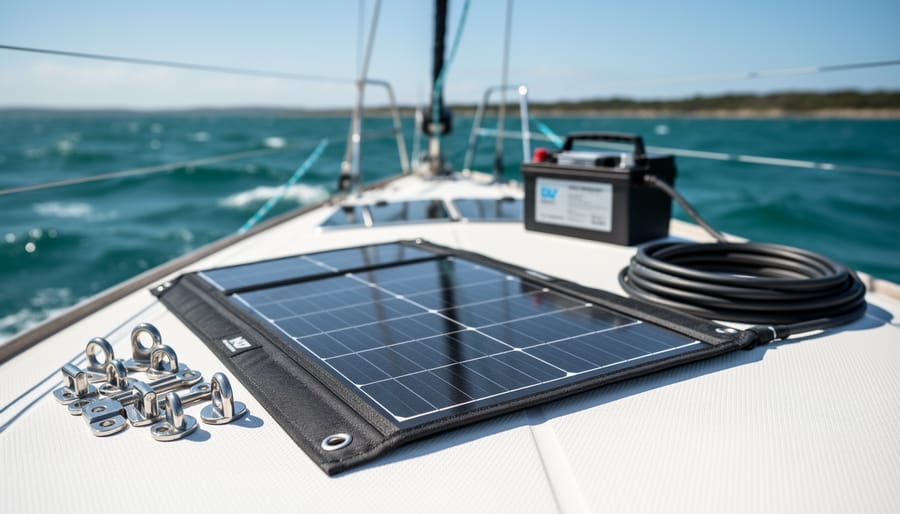
The mounting system deserves attention too. Marine panels need secure attachment points that won’t vibrate loose or corrode, yet allow for occasional removal. Look for panels with multiple mounting options, grommets, corner brackets, or adhesive backing, so you can adapt them to your boat’s layout without drilling unnecessary holes in your deck.
Types of Portable Solar Panels for Boats
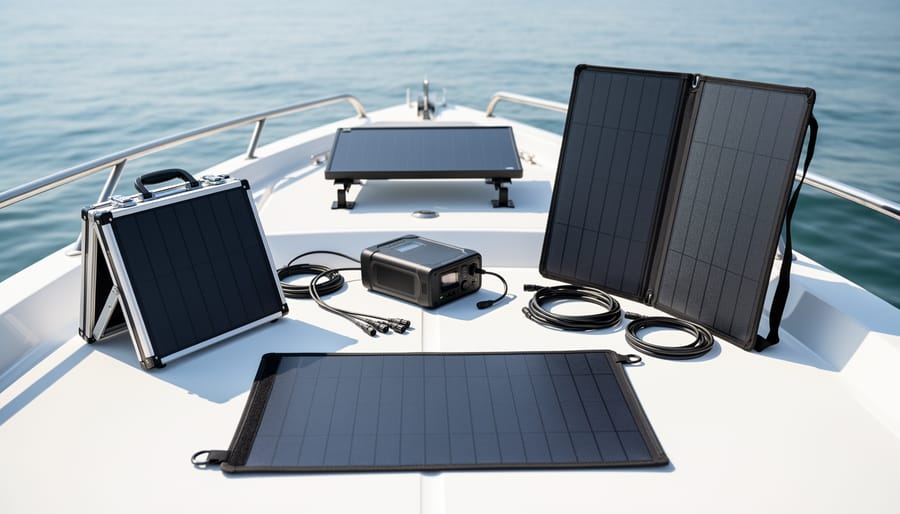
Rigid Panels
Rigid solar panels are the workhorses of marine solar systems, built like traditional rooftop panels with aluminum frames and tempered glass surfaces. They deliver the highest efficiency and longest lifespan of any portable option, often lasting 25 years or more in harsh saltwater conditions. The sturdy construction protects the solar cells from impact and weather while providing excellent heat dissipation, which keeps performance consistent even under intense sun.
These panels require secure mounting, typically using stainless steel brackets, rail systems, or dedicated frames attached to your boat’s deck, hardtop, or arch. While installation takes more planning than simply unfolding a portable kit, the trade-off is stability. Rigid panels won’t flap in the wind or shift during rough seas, and they maintain optimal angles for maximum power generation.
Larger vessels benefit most from rigid panels because they have the deck space and structural points needed for proper mounting. If you’re looking for a set-and-forget solution that will reliably charge your house batteries day after day, rigid panels offer unmatched durability. They handle the constant spray, UV bombardment, and temperature swings that quickly degrade lesser materials. The initial setup effort pays off with years of dependable, maintenance-free power generation.
Flexible Panels
Flexible panels bring solar power to parts of your boat where rigid panels simply won’t work. These thin, lightweight modules can bend to follow the curve of a deck, cabin top, or dodger, making them ideal for vessels with limited flat mounting space or sleek profiles you want to maintain.
The weight advantage is significant. A flexible panel typically weighs half what an equivalent rigid panel does, which matters when every pound affects your boat’s performance and stability. You can walk on many models without damage, and their low profile reduces wind resistance underway.
The trade-offs centre on longevity and heat management. Flexible panels generally have shorter lifespans than rigid alternatives because the thin construction and lack of air circulation underneath cause them to run hotter. Heat degrades solar cells faster, so you might see efficiency drop more noticeably after a few years of continuous use. The adhesive mounting common with flexible panels also makes them harder to replace or reposition once installed.
These panels excel as secondary charging sources on smaller boats, temporary installations, or anywhere the mounting surface curves too much for rigid panels. They’re less suited to being your primary power source on extended cruises where durability and maximum output over time matter most.
Foldable Portable Kits
Foldable portable kits offer maximum convenience for boaters who value flexibility. These suitcase-style panels fold into a compact carrying case, making them easy to stow in a locker or cabin when you’re underway and quick to deploy when anchored or docked.
The biggest advantage is versatility. You can position them for optimal sun angle throughout the day without committing to a permanent mount, perfect for boats where deck space is premium or you need supplemental power during extended stays at anchor. Most kits include built-in legs or stands that let you tilt the panels toward the sun, significantly improving efficiency compared to flat-mounted options.
These systems typically range from 100 to 200 watts and come with integrated charge controllers and connection cables, eliminating the guesswork about compatibility. The self-contained design appeals to beginners who want plug-and-play simplicity.
The trade-off is durability. Because you’ll be handling them frequently, hinges and fabric cases wear faster than fixed installations. They’re also vulnerable to wind if not properly secured during use. Consider foldable kits if you have a smaller vessel, cruise seasonally rather than live aboard, or want to supplement an existing power system during high-demand periods without permanent modifications to your boat.
Key Factors to Consider When Buying
Choosing the right portable solar panel for your boat comes down to matching the technology to your actual on-water lifestyle. Start by understanding your power output needs, add up the wattage demands of your electronics, refrigeration, lights, and communication equipment during a typical day at anchor. A cruiser running a chart plotter, VHF radio, and interior lighting might need 50-100 watts of continuous capacity, while larger vessels with refrigeration and multiple devices may require 200 watts or more. Most boaters underestimate their consumption initially, so track usage over a few trips to build an accurate picture.
The portability versus permanence question shapes everything else. Do you want a solar portable kit that folds away in a locker when you return to the dock, or panels that stay mounted season after season? Foldable kits offer flexibility for smaller boats and weekend sailors who value deck space, while permanently mounted panels suit liveaboards and long-distance cruisers who need unattended charging. Consider how often you’ll adjust panel positioning to follow the sun, portability matters more if you anchor in variable shade or move frequently.
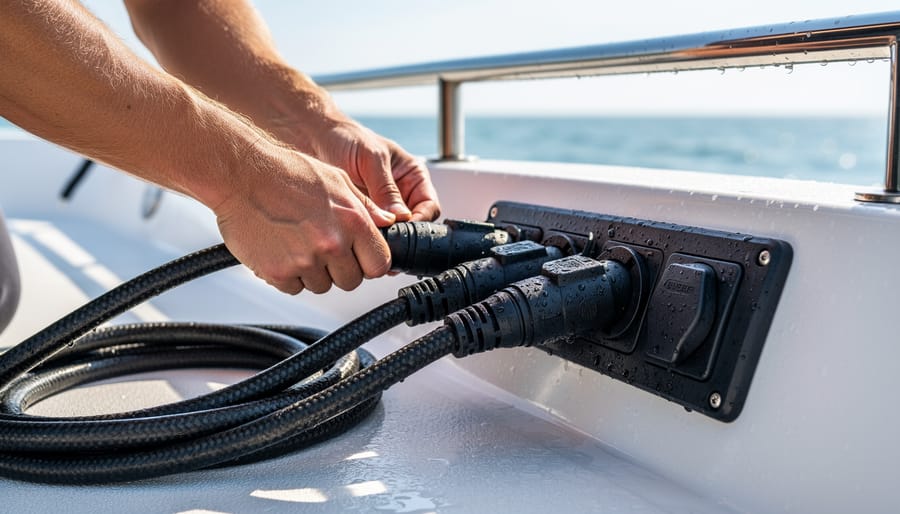
Charge controller compatibility deserves close attention because mismatched components waste energy or risk battery damage. Most portable marine panels include built-in controllers, but verify that yours matches your battery chemistry, lithium batteries demand different charging profiles than traditional lead-acid. Check the controller’s maximum input voltage and current ratings against your panel specifications, and confirm it offers the connection type your boat already uses. Anderson plugs and MC4 connectors are common, but adapters add failure points in a saltwater environment.
Before committing to any system, ask yourself:
- How many amp-hours do I consume on an average day at anchor?
- Will I move the panel between locations, or leave it mounted?
- What battery type and capacity am I charging?
- Do I have unobstructed deck space for permanent mounting?
- Can I safely route cables to my battery bank without drilling?
- What’s my realistic budget including mounting hardware and controllers?
Weight and size constraints matter more on boats than in any land-based application. A 100-watt rigid panel might weigh 15-20 pounds and measure four by two feet, taking up precious deck real estate and affecting your vessel’s balance. Flexible panels cut that weight nearly in half but require careful surface preparation and may trap heat that reduces efficiency. Measure your available mounting area before shopping, accounting for boom swing, foot traffic, and shade from rigging or dodgers.
Budget considerations extend beyond the panel’s sticker price. Quality marine-rated panels cost more than recreational-vehicle equivalents because of enhanced corrosion resistance and UV-stable materials, but they last years longer in harsh saltwater conditions. Factor in mounting brackets, marine-grade wiring, waterproof cable glands, and potentially a battery monitor to track system performance. Spending an extra hundred dollars upfront on proper components prevents expensive replacements and gives you reliable power when you need it most.
Matching Panel Size to Your Power Needs
Start by listing the electronics and appliances you actually use on a typical day aboard. Navigation lights, VHF radio, chart plotter, cabin lights, a small fridge, phone chargers, these everyday items add up quickly. Each device has a power draw measured in watts, and the time you run it determines your total consumption. Your goal is to match your solar panel’s output to that daily demand, plus a buffer for cloudy days or inefficiency losses.
Understanding the basics makes this easier than it sounds. Wattage tells you how much power a device uses at any moment. Multiply that by the hours you run it, and you get watt-hours, the actual energy consumed. For example, a 5-watt LED cabin light running for four hours uses 20 watt-hours. A 50-watt fridge cycling on and off might average 600 watt-hours over 24 hours. Add up all your devices, and you’ve got your daily watt-hour requirement. Amp-hours are just another way to express the same thing, accounting for voltage, most boat systems run on 12 volts, so dividing your watt-hours by 12 gives you amp-hours if your battery capacity is labeled that way.
Real scenarios help clarify the numbers. Say you’re cruising for a long weekend with navigation lights drawing 15 watts for six hours, a chart plotter at 10 watts for eight hours, and a small fridge at 50 watts averaging 12 hours of actual runtime. That’s 90 plus 80 plus 600 watt-hours, totaling 770 daily. Add a 20% cushion for charging inefficiency and variable sunlight, and you’re looking at roughly 925 watt-hours needed. A 100-watt panel in good conditions might produce around 400-500 watt-hours per day, so you’d want at least two panels to cover your usage and keep your batteries topped up.
Don’t forget seasonal variations and your cruising style. If you’re anchoring in the Caribbean with eight hours of strong sun, your panels will produce more than if you’re sailing Pacific Northwest waters under frequent cloud cover. Size your system for the conditions you’ll face most often, not the ideal sunny day. Overestimating slightly beats running your batteries flat and resorting to the generator, which defeats the quiet, sustainable boating experience solar makes possible.
Installation and Mounting Options
Installing portable solar panels on your boat doesn’t require specialized skills, and you have several setup options depending on your vessel type and how often you’ll use the panels.
Temporary mounting is the simplest approach for occasional users. Place panels on deck, secure them with non-slip pads or bungee cords, and angle them toward the sun. This works well for weekend trips or when you’re anchored, though you’ll need to reposition panels as the sun moves and stow them before getting underway in rough conditions.
Rail mounts offer more security while maintaining portability. These clamps attach to your boat’s railings, stanchions or lifelines, and hold panels at adjustable angles. You can leave them in place or remove them quickly when needed. They’re popular on sailboats where deck space is limited.
Permanent brackets provide the most stable installation. Marine-grade aluminum or stainless steel mounts bolt directly to your deck, hardtop, or cabin roof. Once installed, you simply slide panels into the brackets. This setup works best if you’ve committed to solar power and want a low-maintenance solution. Many boaters installing solar panels for yachts choose this method for reliability during extended cruising.
Bimini installations are ideal for powerboats with canvas tops. Panels mount on top of your bimini frame, staying out of the way while capturing sunlight. Some systems integrate directly into the bimini fabric itself.
If you’re uncomfortable with marine electrical systems or drilling into your boat, professional installation typically costs a few hundred dollars and ensures proper waterproofing and wire routing. Most boaters handle temporary setups themselves and consult professionals only for permanent installations.
Common Mistakes to Avoid
The excitement of going solar can lead boaters to rush their purchase, but a few common oversights can turn a promising upgrade into a frustrating experience. Understanding these pitfalls before you buy will save you time, money, and disappointment on the water.
- Underestimating power requirements: Many first-time buyers guess their needs rather than calculating actual consumption. Track your usage over a typical day, add up the watts drawn by your electronics, lights, and appliances, then multiply by hours of use. Build in a 20% buffer to account for inefficiency and cloudy days.
- Ignoring shade and positioning: Even partial shading from rigging, masts, or dodgers can drastically reduce panel output. Survey your deck in different conditions and seasons before committing to a mounting location. If permanent shade is unavoidable, consider portable panels you can reposition throughout the day.
- Choosing panels without marine ratings: Not all solar panels withstand saltwater spray, constant UV exposure, and humidity. Look for panels explicitly rated for marine use with corrosion-resistant frames and sealed junction boxes. Generic camping or RV panels may work initially but often fail prematurely in the harsher boat environment.
- Skipping charge controller compatibility checks: Your panel’s voltage and amperage must match your charge controller and battery type. Mismatched components can undercharge batteries, waste energy, or even cause damage. Verify compatibility before purchasing, or buy a complete system where the manufacturer has already matched the components.
- Forgetting about storage and stowage: Portable panels need a safe place when not in use or during rough weather. Measure your storage areas and consider how you’ll secure panels to prevent movement and damage. Flexible panels roll up for compact storage, while rigid panels require dedicated space.
The most successful solar installations start with honest assessments of actual needs and realistic evaluations of the boat’s layout. Take measurements, calculate your power draw carefully, and don’t hesitate to consult with experienced boaters or marine solar installers if you’re uncertain. A bit of upfront planning prevents the disappointment of a system that doesn’t deliver the independence and performance you expected.
Real Boaters, Real Results
Sarah Mitchell’s 32-foot sailboat spends weeks at anchor in the Pacific Northwest, far from marina power. Before installing a 200-watt portable solar kit, she ran her diesel generator daily just to keep the fridge cold and charge her navigation equipment. “The generator noise shattered the peace we were chasing,” she recalls. Within months of switching to solar, her fuel consumption dropped by 80%, and she discovered she could extend her remote anchoring by two weeks without worrying about battery drain. The quieter mornings meant wildlife approached closer, harbor seals and herons became regular visitors. Sarah also researched how recycling works for panels, ensuring her upgrade aligned with her environmental values from purchase through eventual disposal.
Tom and Linda Chen took a different approach on their 26-foot powerboat. Their weekend fishing trips required running electronics continuously, fish finder, GPS, radio, and livewell pumps. A 300-watt foldable kit eliminated their reliance on a noisy portable generator that used to disturb the fishing spots. “We’re catching more because we’re not scaring them away,” Tom says. The couple calculated they saved roughly 40 gallons of fuel in their first season, which covered half the solar investment. More importantly, they stopped contributing exhaust fumes to the pristine waters they love. Both families now recommend solar to fellow boaters, emphasizing how quickly the technology pays off in freedom and peace of mind.
Main Options Compared
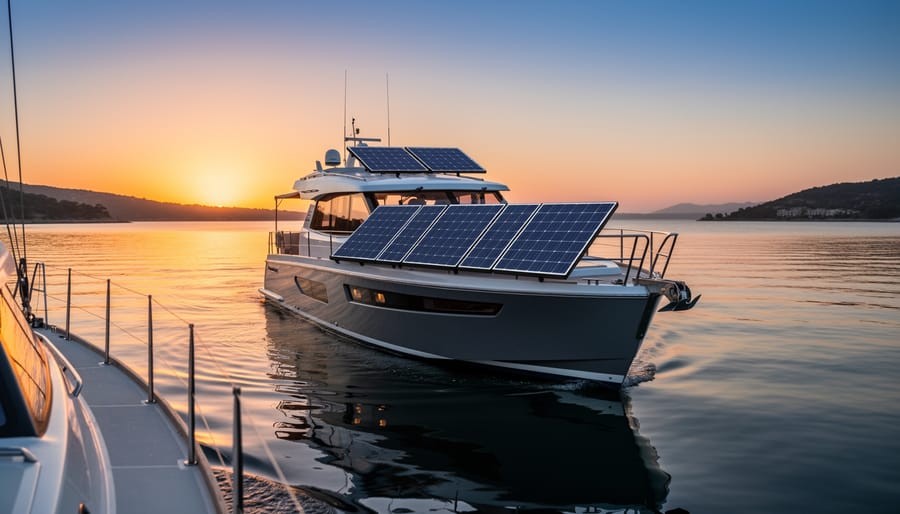
When choosing portable solar panels for your boat, you’re essentially deciding between three main types, each with distinct trade-offs that matter in marine conditions.
Rigid panels deliver the highest efficiency and longest lifespan, typically converting 20-23% of sunlight into usable power. They stand up to the marine environment exceptionally well and perform reliably for 15-20 years. The downside? They require dedicated mounting space and add noticeable weight, making them better suited to larger vessels with permanent installation points.
Flexible panels solve the space problem by conforming to curved surfaces like bimini tops or cabin roofs. They’re lightweight and unobtrusive, but you’re trading longevity for convenience, most last 5-7 years rather than decades. Heat buildup can reduce their efficiency because they sit flush against surfaces without airflow underneath. They work brilliantly on smaller boats where mounting options are limited.
Foldable kits split the difference. They pack down for storage, deploy quickly when you need power, and include built-in charge controllers. Perfect for weekend sailors or supplemental charging. However, they produce less total power than an equivalent permanent setup because you can’t leave them optimally positioned at all times.
Your best choice hinges on whether you prioritize maximum output, minimal space, or flexibility to adapt your setup as your boating habits evolve.
Recommendations by Use Case
If you’re weekend cruising on a sailboat and primarily need to keep navigation electronics and LED cabin lights running, a 100-150W flexible panel offers the sweet spot of light weight, easy storage, and enough output to maintain your house battery between trips. Mount it temporarily on the deck or cabin top when you’re at anchor, then stow it below when underway.
For liveaboard cruisers or those spending weeks at a time off-grid, two or three 200W rigid panels mounted permanently provide the consistent power needed for refrigeration, water pumps, and communication equipment. The durability and efficiency of rigid panels justify their weight on larger vessels where space allows secure mounting.
Budget-conscious boaters adding solar for the first time should consider a foldable 80-120W portable kit with a built-in charge controller. These all-in-one systems remove compatibility guesswork, cost less upfront, and let you test solar power before committing to a permanent installation. They’re also ideal for dinghy sailors or small powerboats where deck space is limited.
Fishing boats and workboats running power-hungry electronics like fish finders, chartplotters, and VHF radios benefit from multiple flexible panels, their low profile won’t interfere with lines or tackle, and you can distribute them across available surfaces to capture sun throughout the day.
Frequently Asked Questions
Do portable solar panels work in cloudy or overcast conditions? Yes, modern marine solar panels still generate power on cloudy days, though output typically drops to 10-25% of peak capacity depending on cloud density. Your panels will collect ambient light even when the sun isn’t visible, making them reliable for extended cruising in variable weather conditions.
How much maintenance do marine solar panels require?
Very little, rinse panels with fresh water every few weeks to remove salt deposits and bird droppings, check connections annually for corrosion, and inspect mounting hardware periodically. Unlike generators, solar panels have no moving parts to service or filters to replace.
Will solar panels work with my existing marine battery?
Most portable solar systems work with standard 12V lead-acid, AGM, gel, and lithium marine batteries when paired with the correct charge controller. Always verify that your charge controller supports your specific battery chemistry to ensure safe, efficient charging.
Can solar panels overcharge my batteries?
Not if you use a proper charge controller, which regulates voltage and current to prevent overcharging. Quality controllers automatically adjust charging rates based on battery state, protecting your investment and extending battery life.
How long do marine solar panels typically last?
Quality marine-rated panels generally maintain 80-85% of their original output after 20-25 years of use. The panels themselves outlast most other boat equipment, though you may need to replace charge controllers or connectors sooner depending on exposure to harsh marine conditions.
Another common concern relates to panel positioning. While permanently mounted panels offer convenience, they may not always face optimal sun angles throughout the day. Portable panels give you the flexibility to adjust positioning as the sun moves or as your boat swings at anchor, maximizing energy collection when you need it most. This adaptability makes them particularly valuable for boats that spend time in marinas or anchorages where shore power isn’t available.
Choosing the right portable solar panel system isn’t just about buying equipment, it’s about claiming a new kind of freedom on the water. You’ve now got the framework to evaluate what truly matters: matching panel type to your boat’s layout, sizing capacity to your actual needs, and avoiding the common traps that trip up first-time buyers. The marine environment demands thoughtful choices, but those choices unlock quieter mornings at anchor, longer cruising ranges, and the satisfaction of powering your adventures with sunlight instead of fossil fuels.
Your next step is straightforward. Review your boat’s power consumption, measure your available mounting space, and decide whether you need permanent installation or portable flexibility. Then choose a system that fits both your technical requirements and your vision for sustainable boating. The technology is proven, the options are accessible, and the benefits extend beyond your own experience, every watt generated from the sun reduces your environmental footprint and demonstrates that modern boating can be both capable and conscientious. You’re not just upgrading your electrical system; you’re joining a movement toward cleaner, more independent time on the water.